
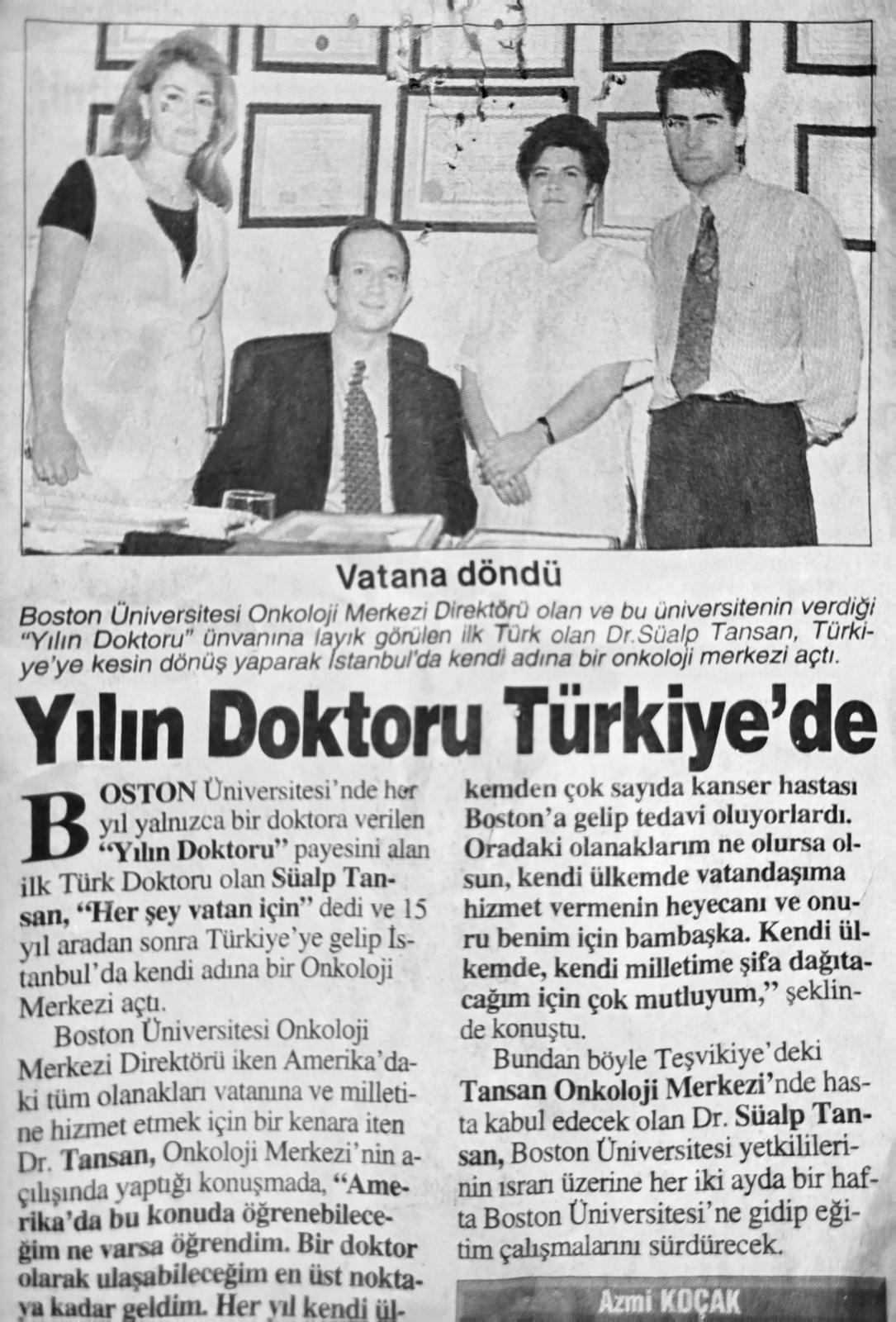

Süalp Tansan, the first Turkish doctor to receive the "Doctor of the Year" award, given annually to only one doctor at Boston University, said, "Everything is for the homeland," and after 15 years, returned to Türkiye and opened an Oncology Center in Istanbul under his own name. While serving as the Director of the Boston University Oncology Center, he set aside all opportunities in America to serve his country and nation.
Click here to go to the link. Kandemir (Konduk) is my dearest friend. He's my best living friend. He had lung surgery. Kando's illness, with whom I've shared so much, even bread, has devastated me. The surgery went well, but his low spirits haven't gone away. Finally, Alper Saldıran, Mustafa Alabora's son, recommended an oncologist for post-operative treatment: Süalp Tansan. I called him late one night, and his assistant gave me an appointment for the next day. [I intervened...]

Click to go to the link. I turned my phone around. “I hope I never end up as your patient, but if I get cancer, I will come to you,” I said. “Who am I speaking to?” she asked. I introduced myself, thinking she would say “Oh,” but she didn’t react at all, even looked for an opportunity to hang up, and finally politely said she didn’t want to give an interview. Well, I also have to present you with a [profile name] every week.
Click here to go to the link. Oncology Specialist Dr. Süalp Tansan stated that cancer patients should especially avoid sugar and excess weight, saying, “When a person learns they have cancer, their relatives bake pastries and cakes for them. Extra calories are harmful to a cancer patient. Limited scientific studies show that if you keep a cancer patient hungry, the response to chemotherapy is better.” He added, “HALF AN AMPULE OF VITAMIN D PER MONTH.”

Click to go to the link. Dr. Sualp Tansarı is one of the leading figures in the fight against cancer not only in Turkey but also worldwide. Born in Istanbul in 1959, the renowned oncologist comes from a family of Circassian origin. His father, Aydın Tansan, who is no longer alive, was a former president of the Turkish Pharmacists Association and the Student Union. Dr. Sualp Tansan attended Kadıköy Maarif College as a boarding student and then continued his education at Istanbul University Faculty of Medicine. After graduating...
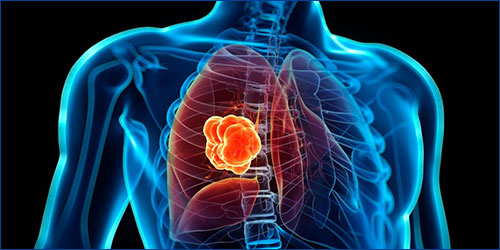
Recent years have brought revolutionary innovations in lung cancer treatment. A group of biological drugs—monoclonal antibodies—called checkpoint inhibitors, or IMMUNOTHERAPY, have become an important part of lung cancer treatment. These drugs activate fighting cells (T lymphocytes) in the immune system to attack the tumor. These drugs either bind to the PD-1 receptor on T lymphocytes (Anti-PD-1 blockers)

Cancer is a disease that has existed since the beginning of humanity. The first steps in modern cancer treatment were taken after the Second World War. The successful use of drugs in cancer treatment began in the 1970s. Treating cancer with drugs is called chemotherapy, and these drugs are called chemotherapy drugs. The most important reason for using drug therapy in cancer treatment is that cancer is generally a systemic disease (meaning it affects many parts of the body).

Cancer has existed on Earth since the dawn of humanity. With increased life expectancy and a decrease in deaths from infectious diseases, cancer became one of the most common diseases of the 20th century. The decline in deaths from cardiovascular diseases in the last decade, and their expected rarity in the future, will make cancer the most significant disease of the 21st century. Cancer is the process by which a cell in our body, one day, loses all its vital functions.

Breast cancer is the most common type of cancer in women. In developed countries, one in every 7-8 women who live to the age of 70 will develop breast cancer. Although the exact figures are unknown in our country, it is an undeniable fact that the incidence of breast cancer will increase due to increasing industrialization and changing dietary habits. In three-quarters of women who develop breast cancer, there is a certain risk factor other than being female.
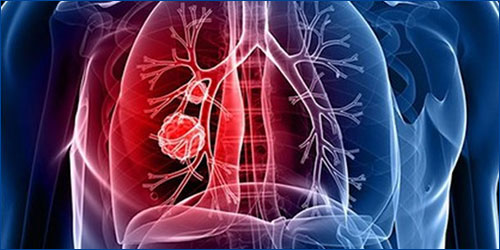
Lung cancer has gone down in world history as one of the most significant diseases of the 20th century. It has been proven, both statistically and biologically, that the most important cause of this disease is smoking. Following the trend of quitting smoking in Western countries, a decreasing incidence of lung cancer cases has emerged, at least in men. In women, deaths from lung cancer have surpassed deaths from breast cancer. Last year...
- 1
- 2